


How to Clean Toys in a Childcare Centre: Methods by Material
Quick answer
To clean childcare toys, remove mouthed or soiled toys straight away, wash hard toys in warm water and detergent, scrub crevices, rinse and air-dry; machine-wash soft toys and dress-ups on a hot cycle; wipe wooden and electronic toys without soaking. Clean toys used that day at close and run every shared toy through a weekly wash rotation. Disinfect only after body-fluid contamination or during outbreaks.
Toys travel from hand to mouth to floor to another child’s hand dozens of times a day. That is exactly what they are for — so the goal is not fewer toys, but a cleaning system that keeps up.
This guide covers every common material in a childcare room and a rotation system that makes toy cleaning manageable for educators and cleaners.
Key takeaways
- Mouthed toys go into a “to be washed” tub and are washed before another child uses them.
- Detergent and water is enough for routine toy cleaning. Sunlight helps dry toys but does not clean them.
- Limit soft toys in baby rooms — they are hard to keep clean.
- During gastro outbreaks, remove soft and hard-to-clean toys and throw out playdough.
In this guide
Mouthed toys: the first rule
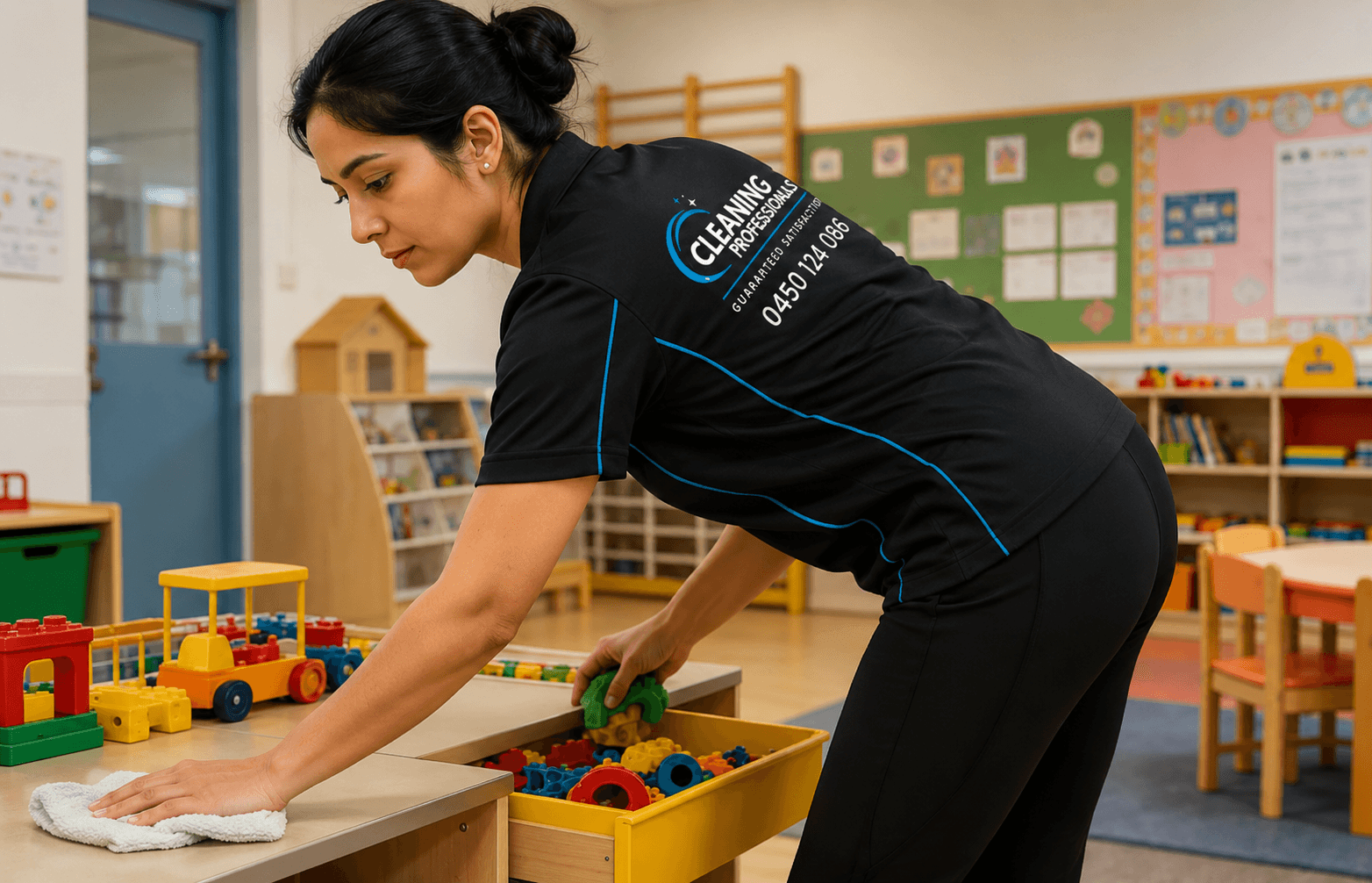
Keep a labelled “to be washed” tub in every baby and toddler room. When a toy has been in a child’s mouth, or is visibly soiled, it goes in the tub straight away. The tub is emptied and the toys washed at least once a day — in nursery rooms, often twice.
Cleaning methods by material
| Toy type | How to clean | Avoid |
|---|---|---|
| Hard plastic (blocks, figures, kitchen sets) | Wash in warm detergent water, scrub crevices with a brush, rinse, air-dry on a rack. Many can go in a dishwasher top rack. | Toys with holes that trap water (e.g. bath squirters) — seal or discard |
| Wooden toys & puzzles | Wipe with a damp detergent cloth, then a damp clean cloth; dry immediately | Soaking — wood swells and splits |
| Soft toys, puppets & dress-ups | Hot machine wash, dry completely in the dryer or sun | Using soft toys in baby rooms unless they can be washed daily |
| Battery or electronic toys | Wipe with a barely damp cloth; device-safe wipe for buttons | Water near battery compartments |
| Books | Wipe covers of board books and wipeable books; retire torn books | Soaking paper pages |
| Dolls with hair | Wash body; hair washed with mild shampoo and dried fully | Leaving damp — mould risk |
| Playdough | Make fresh regularly; discard if a child is unwell or it is visibly dirty | Sharing across rooms during illness |
| Water play | Empty, clean and dry trays and toys daily | Leaving water standing overnight |
| Outdoor toys | Wash weekly or when dirty — see outdoor and sandpit cleaning | — |
Step-by-step: washing hard toys
- 1
Prepare
Fill a dedicated tub (never a nappy-area or kitchen sink) with warm water and detergent.
- 2
Wash
Submerge and scrub each toy, paying attention to seams, wheels and textured surfaces.
- 3
Rinse
Rinse in clean water to remove detergent residue.
- 4
Disinfect if required
Only after body-fluid contamination or during an outbreak: apply disinfectant per label, observe contact time, rinse if the label says so.
- 5
Dry
Air-dry on a rack or clean towel. Return toys to shelves only when fully dry.
Want this cleaning done for your centre?
WWCC-verified, police-checked teams cleaning after hours across Melbourne. A typical 3-hour visit is around $180 + GST, with one fixed price per visit after a free walk-through.
A toy rotation system that works
- Daily: everything from the “to be washed” tub, plus toys used that day in nursery rooms.
- Weekly: every shared toy in every room gets a full wash — scheduled for one night in the weekly rotation.
- Termly: full audit in the holiday deep clean — wash, repair or discard.
- Rotate stock: keep a second set of toys clean in storage and swap sets weekly, so fewer items are out and cleaning keeps up.
Toys during outbreaks
During a gastro outbreak, Victorian Department of Health guidance is to remove soft and hard-to-clean toys, bring out plastic toys that can be washed, throw out playdough in affected rooms and stop sandpit and water play. Clean and disinfect toys at least twice daily. Full protocol: cleaning after an outbreak.
Toy washing is part of every nightly visit by our Melbourne childcare cleaners.
Frequently asked questions
How often should toys be cleaned in childcare?
Mouthed or soiled toys before another child uses them; toys used that day at close; every shared toy weekly; and a full audit each term.
Can you put childcare toys in the dishwasher?
Many hard plastic toys can go in the top rack of a dishwasher, which cleans and heats them. Check the manufacturer’s instructions and avoid toys with batteries or hollow bodies.
Do childcare toys need to be disinfected?
Not routinely. Washing with detergent and water removes most germs. Disinfect after body-fluid contamination or during outbreaks.
Is it safe to use bleach on toys?
Diluted bleach can be used during gastro outbreaks if the toy material allows. Make it fresh, follow the label dilution, rinse afterwards and let toys dry completely before use.
This guide is part of
Childcare Hygiene & Infection Control: A Practical Guide for Australian CentresRelated deep dives
Want this cleaning done for your centre?
WWCC-verified, police-checked teams cleaning after hours across Melbourne. A typical 3-hour visit is around $180 + GST, with one fixed price per visit after a free walk-through.
Sources and further reading
- NHMRC — Staying healthy: Preventing infectious diseases in early childhood education and care services (6th ed.)
- NHMRC — Staying healthy, Part 3: A healthy environment (cleaning, disinfection, body-fluid spills)
- ACECQA — National Quality Standard (Quality Areas 2 and 3)
This guide is general information for early childhood services. Always follow your service's policies, product labels and safety data sheets, and current advice from your regulatory authority and local health department. Prices are guide estimates only; your fixed price is confirmed after a free walk-through.
Related childcare cleaning guides
Infection Control
High-Touch Surfaces in Childcare: What to Clean, How Often & With What
Infection Control
Childcare Hygiene & Infection Control: A Practical Guide for Australian Centres
Infection Control
Safe Cleaning Products for Childcare Centres: What to Use & How to Store It
Checklist
Weekly Childcare Cleaning Checklist with a Monday–Friday Rotation
Infection Control
Childcare Cleaning After a Gastro or Illness Outbreak: Victorian Protocol
How-To Guide
Childcare Outdoor Play Area & Sandpit Cleaning Guide
More Childcare Cleaning Guides
Free, Staying Healthy-aligned checklists, hygiene guides and pricing advice for childcare centres and kindergartens.
Childcare Cleaning Cost in Melbourne (2026): Per-Visit, Hourly & Monthly Prices
2026 Melbourne childcare cleaning prices: per visit by centre size, hourly rates, monthly budgets, deep cleans, outbreak cleans and what drives your quote. Typical 3-hour visit $180 + GST.
Read Guide
Childcare Cleaning Checklist: Daily, Weekly, Monthly & Termly (2026 Guide)
Room-by-room daily, weekly, monthly and termly cleaning tasks for childcare centres — aligned with NQS Quality Areas 2 and 3 and the NHMRC Staying Healthy guidelines.
Read GuideHow Often Should a Childcare Centre Be Cleaned? Frequency Guide by Area & Centre Type
After each use, daily, weekly, monthly or termly? A clear frequency table for every area of a childcare centre, plus recommended professional cleaning schedules by centre type.
Read GuideChildcare Hygiene & Infection Control: A Practical Guide for Australian Centres
The five habits that stop germs spreading in childcare — and exactly where cleaning, disinfecting, ventilation and exclusion fit, based on NHMRC Staying Healthy (6th ed.).
Read GuideHow to Clean a Childcare Centre: Step-by-Step Methods Professionals Use
The order, equipment and techniques professional cleaners use to clean a childcare centre properly every night — from play rooms to nappy areas — without cross-contamination.
Read GuideHow to Choose a Childcare Cleaning Company in Melbourne: 10 Questions to Ask
Ten questions to ask, the compliance documents to request and the red flags to avoid when choosing a childcare cleaning company in Melbourne — plus how to compare quotes fairly.
Read GuideDaily Childcare Cleaning Checklist: Opening, During the Day & Close
Opening checks, after-use tasks and the nightly close-down clean for every room in a childcare centre — split between educators and cleaners.
Read GuideWeekly Childcare Cleaning Checklist with a Monday–Friday Rotation
Every weekly task a childcare centre needs, spread across a Monday–Friday rotation so the nightly clean never runs over time.
Read GuideChildcare Deep Cleaning Checklist: School Holiday & End-of-Term Reset
Everything to include in a childcare deep clean during school holidays or the Christmas shutdown — room by room — with timing, planning and cost guidance.
Read GuideChildcare Bathroom Cleaning Checklist: Toilets, Potties & Basins
After-use, daily and weekly bathroom tasks for childcare centres — child toilets, potty chairs, basins, floors and drains — with the right products and colour coding.
Read GuideChildcare Kitchen Cleaning Checklist: Food Prep, Bottles & Dining
After-use, daily, weekly and monthly cleaning for childcare kitchens, bottle-prep zones and dining areas — and how it fits with your food safety program.
Read GuideNappy Change Area Cleaning Checklist for Childcare Centres
The after-every-change cleaning procedure, end-of-day nappy area clean, nappy bin hygiene and set-up tips — based on the NHMRC Staying Healthy guidelines.
Read GuideChildcare Sleep Room Cleaning Guide: Cots, Mats & Linen
Daily, weekly and termly cleaning for cots, mattresses, rest mats, linen and the sleep room itself — gentle enough for babies, thorough enough to stop germs spreading.
Read GuideChildcare Outdoor Play Area & Sandpit Cleaning Guide
Daily checks, sandpit care, play equipment, soft-fall, water play and outdoor toys — a practical outdoor cleaning routine for childcare centres.
Read GuideChildcare Cleaning Log Template: What to Record & How to Use It
Copy-ready cleaning log templates for childcare: nightly room sign-off, weekly rotation, toy washing, spills and outbreaks — and how to use them for NQS evidence.
Read GuideHigh-Touch Surfaces in Childcare: What to Clean, How Often & With What
The 25 most-touched surfaces in a childcare centre, how often to clean them, and when cleaning should become disinfecting.
Read GuideSafe Cleaning Products for Childcare Centres: What to Use & How to Store It
The short list of products a childcare centre really needs, how to choose disinfectants, bleach safety, low-tox options, and storing chemicals safely around children.
Read GuideChildcare Cleaning After a Gastro or Illness Outbreak: Victorian Protocol
The Victorian gastro outbreak cleaning protocol for childcare: when it is an outbreak, who to notify, how to clean vomit and diarrhoea, and the final clean before reopening rooms.
Read GuideNQS Cleaning Requirements for Childcare: Regulations, Elements & Evidence
The regulations and NQS elements that relate to cleaning, what “clean and well maintained” means in practice, and the evidence that helps at assessment and rating.
Read GuideChildcare Centre Carpet & Rug Cleaning: Frequency, Methods & Cost
Daily, weekly and periodic carpet care for childcare centres, cleaning vomit and urine from carpet, choosing a method, and what it costs in Melbourne.
Read GuideProfessional vs In-House Childcare Cleaning: True Cost Comparison
A side-by-side comparison of employing your own cleaner versus contracting a cleaning company — including the costs that are easy to miss.
Read GuideKindergarten Cleaning in Melbourne: Checklist, Schedule & Costs
How kindergarten cleaning differs from long day care, a daily checklist for sessional kinder, who is responsible in council buildings, and what it costs in Melbourne.
Read GuideFamily Day Care Cleaning Checklist: Daily, Weekly & Safety Tips
A home-based version of the childcare cleaning checklist for family day care educators — what to do before children arrive, during care, after pick-up and weekly.
Read GuideChildcare Cleaning in Inner Melbourne: CBD, Carlton, Richmond & Fitzroy
How childcare cleaning works for inner-city centres in office towers, apartment podiums and converted warehouses across the CBD and City of Yarra.
Read GuideChildcare Cleaning in Melbourne’s Northern Suburbs: Craigieburn to Brunswick
Childcare cleaning across Hume, Whittlesea, Merri-bek, Darebin, Banyule and Nillumbik — from new growth-corridor centres to established community kinders.
Read GuideChildcare Cleaning in Melbourne’s Western Suburbs: Point Cook to Footscray
Childcare cleaning across Wyndham, Melton, Brimbank, Maribyrnong, Hobsons Bay and Moonee Valley — some of Melbourne’s busiest childcare growth areas.
Read GuideChildcare Cleaning in Melbourne’s Eastern Suburbs: Box Hill to Ringwood
Childcare cleaning across Whitehorse, Monash, Manningham, Maroondah and Knox — established family suburbs with high demand for quality early learning.
Read GuideChildcare Cleaning in Melbourne’s Inner South East: Hawthorn to Brighton
Childcare cleaning across Boroondara, Stonnington, Port Phillip, Glen Eira and Bayside — premium centres, heritage buildings and bayside kindergartens.
Read Guide